
Gallery
Real-time captures, exactly as they came off the GPU, with nothing done to them afterwards. Open one for the note on what you are looking at.
-
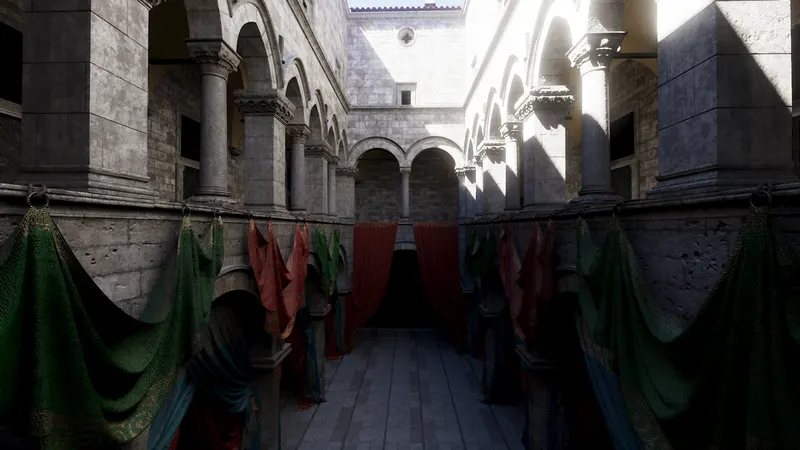 Sun and indirect bounce
The colonnade never sees the sun. All the light down there bounced off something else first.
Sun and indirect bounce
The colonnade never sees the sun. All the light down there bounced off something else first.
This is Intel's Sponza, the atrium every renderer gets tested in. The sun is high and to the right, and it only lands directly on the upper storey and the far wall. The whole lower colonnade, the curtains and the floor are in shadow, but none of it is black. All the light down there was traced from the sunlit stone above, bounced once or twice, and found its way in under the arches.
Look at the colour of it. The shade is warm where the stone is warm, and it picks up a green or red cast next to the fabric, because bounced light carries the colour of whatever it left. Baked and probe-lit interiors get this wrong, and a windowless place is lit by almost nothing else.
-
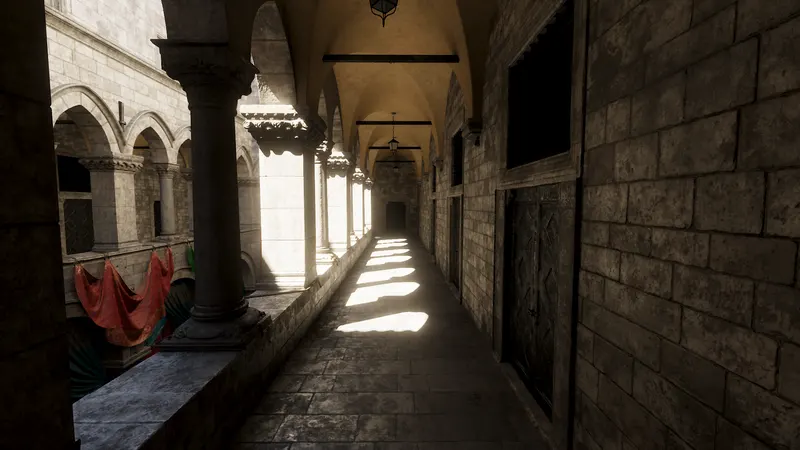 Lit from the floor
The lamps up there are off. The vault is lit by sun coming back up off the stone.
Lit from the floor
The lamps up there are off. The vault is lit by sun coming back up off the stone.
One of the side corridors of Sponza. Hard sun comes in between the columns and lands on the floor in sharp shapes, and the lanterns hanging from the vault are off, so the ceiling, which nothing points at, is lit by the floor. Light hit the flagstones and went back up, a little dimmer with each bounce and a little warmer each time it left the ochre plaster.
You can see it in the gradient along the vault. It is brightest above the sunlit patches and fades towards the far end, where the sun no longer reaches the floor, and the whole thing moves as the sun does. A corridor in the Backrooms is lit by exactly this kind of light, only from the wrong side.
-
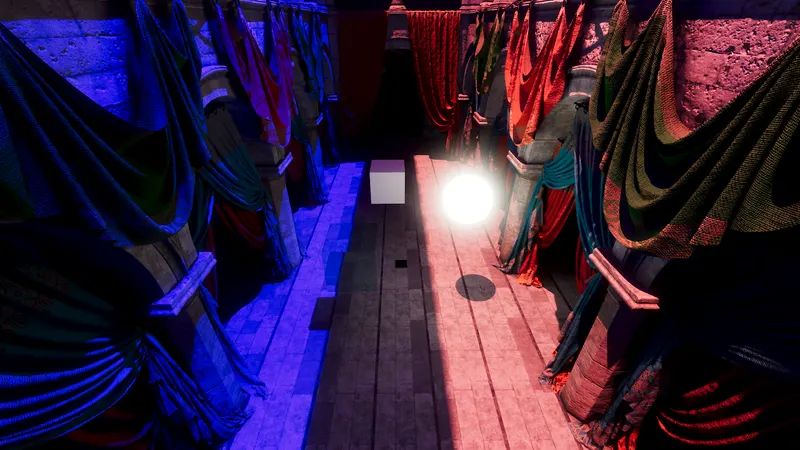 Many lights at night
Coloured sources and a glowing sphere, all of them live, all of them casting and bouncing every frame.
Many lights at night
Coloured sources and a glowing sphere, all of them live, all of them casting and bouncing every frame.
The Sponza atrium at night, with the sun gone and a handful of lights placed by hand: a saturated blue on the left, a red on the right, and a white sphere in the middle that is an emissive surface glowing on its own, with no lamp inside it. Every one of them casts a shadow and every one of them bounces, so the blue floods the stone on its side and the red bleeds across the fabric on the other.
None of this was computed ahead of time. Any of these lights can be moved, dimmed or switched off and the room answers in the same frame, which the game depends on, because in the Backrooms the lighting is part of the horror and has to be able to change on you.
-
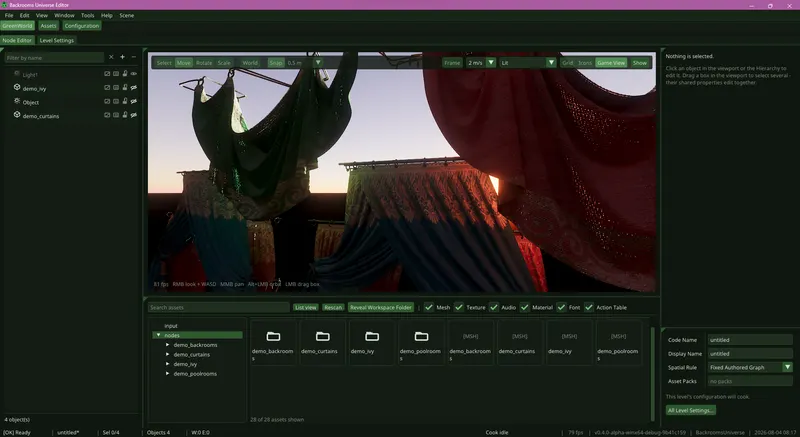 What the author sees
The editor's viewport runs the game's actual renderer. The dusk in it is the real sun, sitting low.
What the author sees
The editor's viewport runs the game's actual renderer. The dusk in it is the real sun, sitting low.
The editor is one of the four programs the engine ships as, and its viewport draws through exactly the same pipeline as the game client. What is on screen here, curtains lit from behind by a sun a few degrees above the horizon and a sky that agrees with it, is what a player would see standing in the same spot.
The sun here is a real body with an angular size and an atmosphere around it, so dusk actually looks like dusk: the light goes long and orange, the shadows soften, and the sky darkens from the top down. Around the viewport are the scene tree, the asset browser and the level's settings, which is how everything gets authored: whatever you place in a level is a component, and the level itself is data.